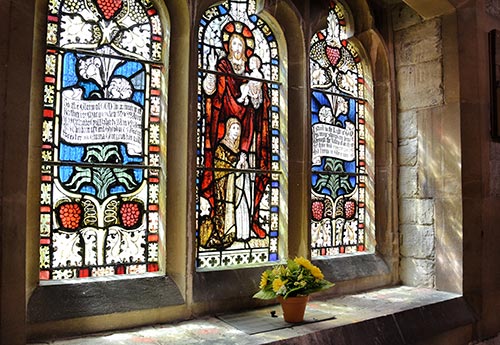
First consecrated in July 1884, the church sits at the heart of Westgate-on-Sea on the north coast of Kent.
A History of the Bells of St Saviour’s Parish Church Westgate-on-Sea
Introduction
St Saviour’s tower originally held one bell, provided in 1884 when the church was built, which was 25” diameter, weighing 3 cwt, 1 qr. 14 lbs and was supplied by Messrs. Gillett & Bland of Croydon.
This bell was replaced in 1913 by a memorial bell, note F, 46” diameter, weighing 17 cwt. 2 qr. 6 lbs and was inscribed:
A.M.D.G. ET IN PIAM MEMORIAM PASTORIS SECUNDI
T.W.MYLNE
D.D.AMICI DISCIPULI MCMXIII
and the medallion inscribed:
JOHN AND DENISON TAYLOR
LOUGHBOROUGH
Nothing changed after 1913 at St Saviour’s, until 1975…
The bells of Holy Cross church, Canterbury
The former Holy Cross church was rebuilt in 1381, following the rebuilding of the adjacent West Gate of the City by Archbishop Sudbury. Its predecessor, in common with other City churches at that time, was actually over the West Gate; but the massive defence we now see precluded any such continued arrangement. The new church was of typical Kentish type, nave and chancel with no structural division, a short north aisle with porch and parvise, and a south aisle terminating in a tower engaged at the west end. Much of the 14th century work was obliterated at the time of an extensive restoration in 1879-80, when the tower was rebuilt from the ground level, all the windows renewed, and new furniture introduced. Many fine monuments were allowed to remain, along with some ancient misericords (now in the Chantry of Eastbridge Hospital Chapel) and plain perpendicular font with a magnificent ‘tabernacle’ cover, now in the great church at Minster-in-Thanet. In 1963, Holy Cross was closed for parochial purposes and turned into an inter-denominational centre for the University which was two miles away. Not surprisingly that experiment failed, and in 1968 it was closed for good.
Owing to many misgivings about their condition, Holy Cross bells had not been rung in the traditional manner since 1923. They were for many years chimed, but after the closure of the church the belfry became the haunt of the City’s pigeons, and eventually the weight of their droppings made it impenetrable. The framework and fittings, already in a bad state, deteriorated even further.
It is probable that one of the bells may have hung in the former church which was over the West Gate; the present fourth bell (now the fifth bell at St Saviour’s) was cast by Stephen Norton of Maidstone in the period 1360-1380. Alternatively it may have been cast for the rebuilt church in 1381. Its inscription is in very fine Lombardic lettering, each letter and stop crowned. At the time of Edwardian Inventory (1552-1553) there were four bells; what happened to the later is not known, but in 1608 the then treble and tenor bells were recast by Joseph Hatch who gave it a very finely ornamented set of canons, moulded in the likeness of faces. The canons of all these four bells have been retained on their heads in the restoration at Westgate-on-Sea.
Records show that on March 9th 1729…
”At a Vestry holden in ye Parish Church of Holy Cross Westgate in Canterbury By ye parishioners it was unanimously agreed That ye Church Wardens have a sess Granted at ye rate of one shilling in Ye pound to buy a new bell. That it is to be a treble bell to make ye ring better and ye said bell is not to Cost above twenty-one pounds Allowed by us”.
The new treble bell was cast by Samuel Knight of Holborn, who did a roaring trade in Kent in the Years 1721-1730; he cast the new ring of eight bells for Canterbury Cathedral in 1726. For some reason, the treble he cast for Holy Cross was not a good bell, and it was recast by Thomas Lester of Whitechapel in 1739.
Since that time repairs have been made to individual bells; the fittings were mainly identified as 19th century work (the second headstock was dated 1802), and the bell frame dated from 1730, at least in part. It is strange that, when the tower was rebuilt in 1879, the bells seem to have been taken down with the frame and rehung exactly as they had previously. The last ringing of the five bells was in 1923, and in 1935 they were condemned by Messrs Gillett & Johnstone of Croydon, who quoted the princely sum of £273 inclusive of all builders work for rehanging, retuning and quarter turning the bells and providing all new fittings with a new six-bell frame. This work was not carried out.
Transferring the bells from Holy Cross to St Saviour’s
After the virtual abandonment of Holy Cross church in 1968, concern was expressed amongst Canterbury bell ringers as to the future of the bells. This crystallised into some sort of action when the then Diocesan Advisor, Mr D. L. Cawley, with the great help of the then Archdeacon, the Venerable Michael Nott, evolved a plan whereby the bells should be removed by members of the Kent County Association of Change Ringers (KCACR) and held in trust by them for the Diocese at a bell foundry, pending the association’s success in finding a new home. The Faculty for this work was finally granted in May 1972 and the bells removed to Whitechapel Foundry under Mr Cawley’s direction – Archdeacon Nott even ascended to the top to lend a hand with the work going on. Another assistant was Mr James Stockbridge, who had taken part in the last ringing on the bells forty years before.
Shortly after, Mr Crawley departed to be ordained in Norwich, and his successor Mr A.P.S Berry, General Secretary of the KCACR pursued efforts to get the bells housed elsewhere. Fortunately, the then Chairman of the Association, the Revd Stanley M. Evans had recently been inducted as the incumbent of St Saviour’s Parish Church, Westgate-on-Sea, which had an ample tower containing only one very large bell. Revd Stanley was offered the bells and his Parochial Church Council (PCC) decided it must accept this offer and go forward in faith, after a very generous anonymous donation of £500 had been received, which was soon followed by numerous other donations. On the 5th December 1973 Mr Berry was able to write to the Diocesan Registrar that the Association recommended the transfer of the bells from Holy Cross, Canterbury to St Saviour’s Parish Church, Westgate-on-Sea.
The installation and Dedication of six bells at St Saviour’s
In 1975 the five bells of the former Holy Cross church, West Gate, Canterbury, which had lain in storage, were allowed to have a new home with virtually the same name! The bells were tuned and the existing treble was cast from the metal of the former bell of St Saviour’s.
The new treble bell, with a diameter of 26 5⁄8 inches is inscribed on the shoulder:
ALLELUIA TO THE SAVIOUR
WHO HAS GAINED THE VICTORY
And around the waist of the bell it is inscribed:
I WAS CAST FROM THE 1913 MEMORIL BELL IN MEMORY OF
T.W. MYLNE VICAR 1900/1913 TO TREBLE THE PEAL OF FIVE
FROM HOLY CROSS, WEST GATE, CANTERBURY
TRANSFRERRED HERE EASTER 1975 STANLEY MUNRO
EVANS VICAR
J.J.S. BURY R.J. MILLARD CHURCHWARDENS
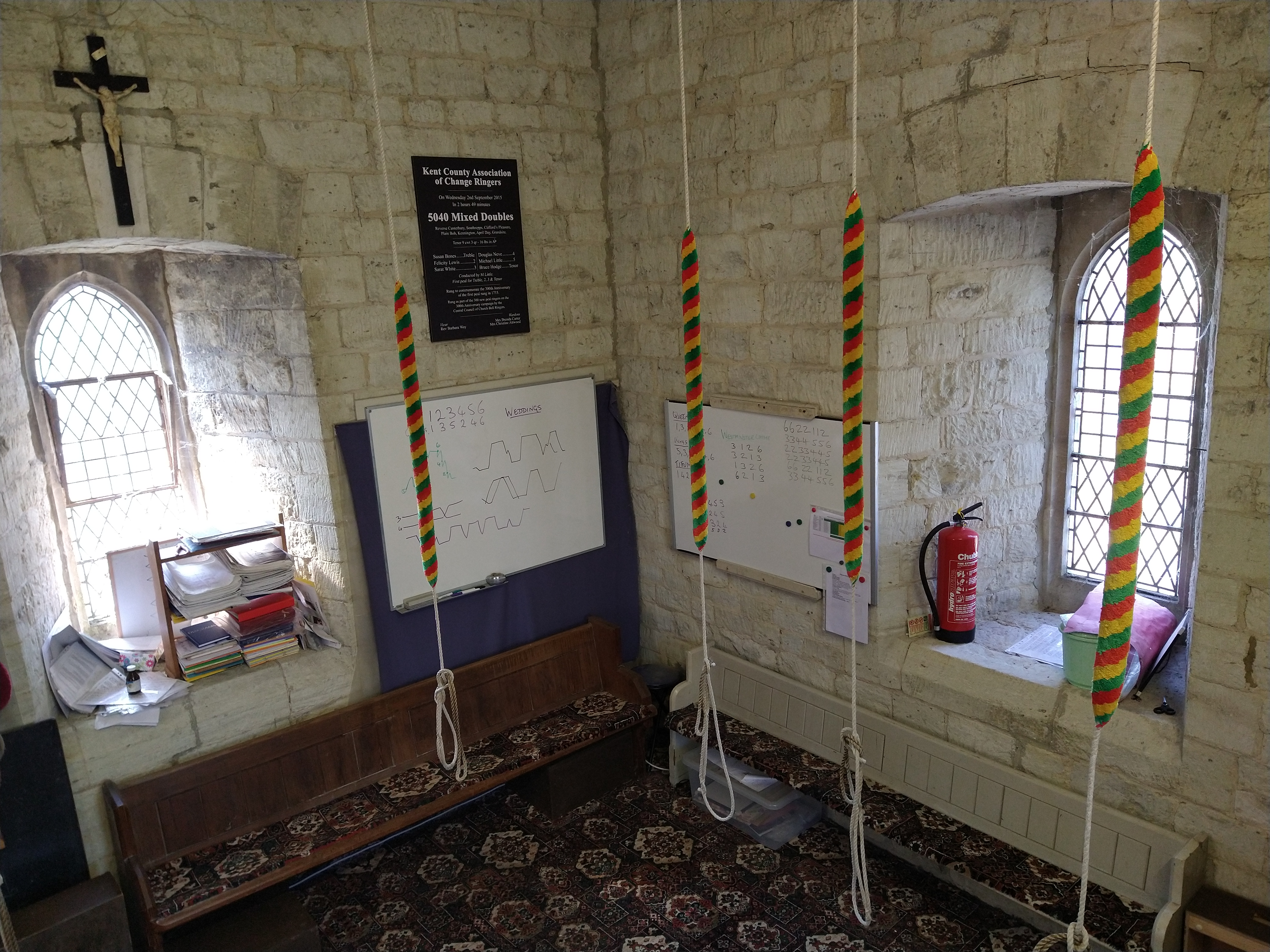
The bells have been hung with all new fittings in a massive new Iroko 8-bell frame made at Whitechapel Foundry in 1975. The installation was carried out most efficiently by a member of the KCACR, Mr Stuart Taylor, ably assisted by his wife, Messrs P & S Jackman and some of the ringers of Westgate-on-Sea.
On Saturday 19th July 1975 at 4pm a Dedication of the Bells service was held by the Archdeacon of Canterbury. During the service a procession was formed consisting of the Crossbearer, the Choir, the Verger, the Bell Ringers and Bell Founder, the Clergy, the Churchwardens, the Archdeacon and the vicar, whilst the congregation sang the hymn; Christ is risen! Christ is risen! He hath burst His bonds in twain.
At the conclusion of the service a band of ringers were invited to ring a touch of Kent Treble Bob Minor. The congregation were invited to tea in St Saviour’s Church School, Elm Grove, after which the bells were available for general ringing.
Stephen Norton – Medieval Bell Founder
Only two other bells by Stephen Norton are known to exist; the second bell at Snave in Romney Marsh, which is slightly smaller but similarly inscribed with:
+ STEPHANUS: NORTONE: DE: KENT: ME: FECIT
using very fine crowned capitals, and a dotted diamond between two roundlets for a word stop. And second bell of the ring of five at Chiselborough, Somerset.
Norton is described in the Pedes Finium of the thirty-sixth year of Edward III as "Brasiere", and he is selling land in Goudhurst. In the next year he is buying houses and land in Boughton Monchelsea, and the same name, probably indicating the same man, appears in a conveyance of some Wrotham property in 1375. But through the care of Kentish antiquaries he has also been traced to St. Mary-in-the-Castle, Dover.
There is a church brass given) to Sir Robert Astone circa 1630, and the following note is added by Sir Edward: "The circumscription of the great bell heere, and weighing 3000 Ib. weight, and which was the gift of that Sir Robert Astone, hath every letter fayre and curiously cast, and each crowned with a ducal crown, " Dominus Robertus de Astone Miles me fecit fieri A quarto R. Ricardi scdi G."
Below this in small letters was cast;
Stepne NortonE of Ket
Me made i God Entet
Now this very couplet, with " Kent " and " intent " shortened into "Ket" and "entet," and "i" for "in," is found on the third bell in the tower of Chiselborough, near IIminster. The initial cross and word-stop are of great beauty, and the lettering unusually tall and elegant, but quite unlike those on the Canterbury and Snave bells. What could have taken this "man of Kent" all the way to a remote Somerset village is a mystery. We have no trace of him enroute. In 1394 two Stephen Nortons, of Chart Sutton, father and son, are permitted by an Ad quod damnum writ to assign to the Convent at Modynden interalia nine acres of meadow in "Bocton Monchesy (Boughton Monchelsea)." Considering that our Norton bought lands there, it argues for the identity of the two.
However, there is no evidence of a foundry in such a village as Chart Sutton. Some foundries were in villages, e.g. at Aish Priors, Somerset. Perhaps, like some business people of today, Norton preferred to live on his land in a village and carry out his work in the adjoining town of Maidstone.
The fifth bell at St Saviour’s which was made by Stephen Norton in 1375 is believed to be one of the oldest church bells, still being regularly rung.
Click here to see the details of the current bells at St Saviour’sAbout St Saviour's